

Did you know that the intervertebral discs of the spine are mostly avascular?
That means they have a very poor blood supply, and therefore rely on another mechanism to supply their nutrition and remove waste products from cellular function, and that is movement!
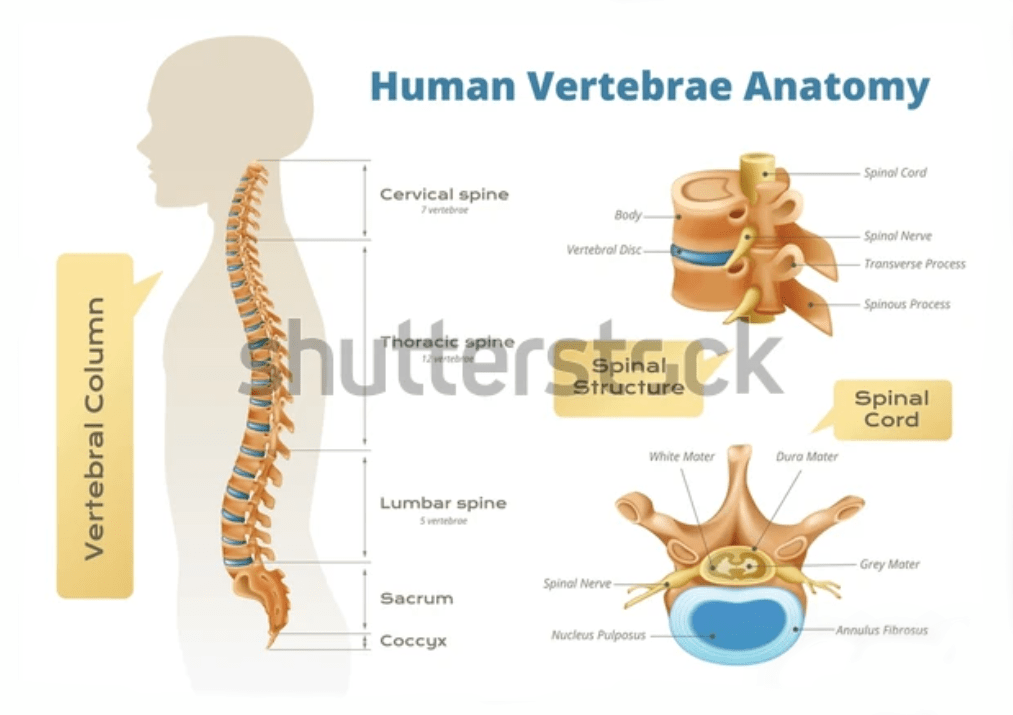
Did you know?
* The spine has 33 bones with discs between each
* The nucleus (inside) is made of 60-80% water
* The annulus (outside) is made of layers of collagen and provides stability.
* The discs are mostly avascular (have poor blood supply)
Discs require movement to transport nutrients in and waste out.
So how does movement help the health of my spine?
By moving your back regularly and properly, you help move good nutrients into the discs and remove waste products out of the discs. This helps maintain disc health and function and helps prevent the onset of Intervertebral Disc Degeneration (IDD)1,2.

Disc degeneration can start with changes to the chemical environment of the cell, caused by activities like axial compression, static loading, improper dynamic loading, or direct trauma1,2,4,5.
If unchecked an altered disc environment can cascade from small, isolated microtrauma, to a breakdown of the structural environment, impaired function of the spinal segment, and can potentially progress to affect the biomechanics of adjacent spinal regions4.
IDD can become irreversible if it isn’t identified and treated early5.
IDD is one of the most common causes of low back pain1, and affects up to 1 in 6 of the Adult Australian population3. It is more common with aging3.
Disc bulge, herniation, protrusion, extrusion, sequestration, and disc desiccation are all terms describing various levels of severity of potential disc pathology6.



How do I help prevent disc degeneration?
Frequent, healthy movement is key! One of the biggest risk factors is lack of movement, dysfunctional loading patterns, and poor spinal biomechanics2,7,8.
Activities involving axial compression, static loading (like sitting for extended periods), or repetitive dynamic loading temporarily deform the disc, which alters its functional capacity.
- Take micro-breaks every 20-40 minutes
– Limit the amount of time doing repetitive and/or static activities (e.g. sitting, driving, standing still, lawnmowing, weeding, repetitive lifting)
– Do the opposite movement (e.g. if you’ve been bent forward, take a moment to stand up straight, and slightly bend backward) - Have a good rest
– Decompression of your spine (laying down, or stretching) allows for the stressed, dehydrated disc to rehydrate
– Get a good night’s sleep, in a healthy, supported position - Stretch and move intentionally every day
– Our ‘Spinal hygiene’ routine is excellent
– Get 30 minutes of aerobic exercise each day (walk, swim, ride a bike, dance, whatever you enjoy, just get moving!) - Move correctly – don’t take the quick and ‘easy’ route!
– Move your feet
– Bend your knees
– Engage your core muscles (we promise they exist!)
– Carry any weight as close to your torso as possible - Target weak, overused, or short muscles
– Talk to the team at Caring Hands Chiropractic about your specific case, and we can help you identify which muscle groups need what interventions - Get the right nutrition
– Anti-inflammatory (high in fish/omega-3s) and nutrient-dense varied diets are crucial for your body to function well

Most importantly, get checked!
While most people have a general idea of how to move, it’s very difficult to assess each individual spinal motion segment on yourself, even our chiropractors regularly get checked by each other!
Catherine uses the analogy of a Chiropractor being similar to a Mechanic: you may be able to fill with fuel, change a tyre, maybe even change your engine oil; but the last thing you want is for any warning lights to come on – that’s expensive and time-consuming!
One main difference is that the car gets a break while you’re at work, or overnight while you sleep, but our body is constantly working, even while we sleep! It’s time to show it some TLC, so we can keep working hard and playing hard.
+ note: all advice is generalised, please speak to your practitioner for advice on your specific case. Don’t do any activities that cause or aggravate symptoms.

References:
[1] Wang, SZ., Rui, YF., Tan, Q. et al. Enhancing intervertebral disc repair and regeneration through biology: platelet-rich plasma as an alternative strategy. Arthritis Res Ther 15, 220 (2013). https://doi.org/10.1186/ar4353:
[2] J Chiropr Med. 2018 Jun; 17(2): 97–105. Published online 2018 Jun 14. doi: 10.1016/j.jcm.2017.11.006:
[3] Australian Institute of Health and Welfare (2020) Back problems, AIHW, Australian Government. https://www.aihw.gov.au/getmedia/581d5cd8-d09b-4c77-bd99-c9a27cd154f3/Back-problems.pdf.aspx?inline=true
[4] Freemont AJ: The cellular pathobiology of the degenerate intervertebral disc and discogenic back pain. Rheumatology. 2009, 48: 5-10.
[5] Yang SH, Lin CC, Hu MH, Shih TT, Sun YH, Lin FH: Influence of age-related degeneration on regenerative potential of human nucleus pulposus cells. J Orthop Res. 2010, 28: 379-383.
[6] Intervertebral disc. (2022, June 30). Physiopedia, from https://www.physio-pedia.com/index.php?title=Intervertebral_disc&oldid=310522
[7] Choi YS: Pathophysiology of degenerative disc disease. Asian Spine J. 2009, 3: 39-44.
[8] Schoenfeld AJ, Nelson JH, Burks R, Belmont PJ: Incidence and risk factors for lumbar degenerative disc disease in the United States military 1999-2008. Mil Med. 2011, 176: 1320-1324.
 Caring Hands Chiropractic