

Returning to exercise postpartum can be tough.
There are many barriers, including physical discomfort, social isolation, financial constraints, and difficulties in being able to prioritise your health over all the other things on your plate at the time.
You also just may not be interested. I get it. I wasn’t either. I was happy in my bubble with my beautiful baby just chilling out at home. This is totally ok!

When you are ready to get back into it there are a few things we need to keep in mind:
1. Pregnancy hormones remain in the system for many months. For those who are breastfeeding, it’s longer still. This makes our joints more flexible and ‘unstable’. This means it’s a lot easier to injure yourself.
2. Take it slow – don’t expect to be back up to your pre-baby lifting weight or run-time right away
3. Never prioritise exercise over sleep – it is essential that you get enough rest. It may sound like a clique but you cannot pour from an empty cup.
4. Get checked – I’m talking about your pelvic floor and abdominal muscles. This is so important. Pelvic floor issues and diastasis recti are very common. Ask your chiropractor if they can help.
5. If it hurts (I don’t mean that uncomfortable muscle burn), stop. Go and see your health practitioner to make sure what you are doing is right for your body at this time.
6. Almost one-third of Australian mothers give birth via Caesarean section. Mothers who have birthed their babies via Caesarean section or operative vaginal delivery (episiotomy, use of forceps, potentially vacuum) will have slightly longer recovery timeframes, compared with those with uncomplicated vaginal deliveries.
7. Many women suffer from persistent musculoskeletal pain after birth. This is where your chiropractor may be able to help.
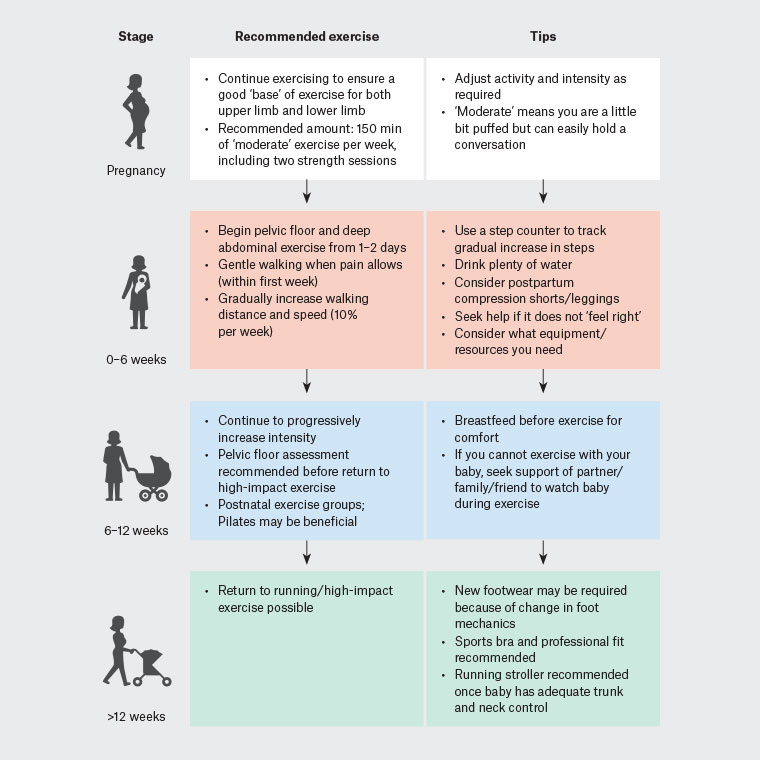
This infographic outlines the most current guidelines as recommended by the Australian Journal of General Practice
My experience with returning to exercise following the birth of my son has been a long and painful one. Prior to having my son, I was that person who exercised 5-6 days per week – no matter what. I birthed my son via emergency caesarean in December 2020. I had a long recovery. I attempted to return to walking at 12 weeks, however, was met with an increase in abdominal and pelvic pain in addition to my significantly reduced level of fitness.
Much of the abdominal pain has resolved, however, I have been gently working through the pelvic injury (osteitis pubis) ever since. I have amazing practitioners and an awesome trainer who is always supportive and willing to give me a more suitable exercise if something doesn’t suit. This experience has definitely taught me to honour my body, slow down and just do what I can.
Please have a chat with your chiropractor or health professional before returning to or commencing any exercise at any time.
References:
https://www1.racgp.org.au/ajgp/2022/march/exercise-after-pregnancy
Grivell RM, Dodd JM. Short- and long-term outcomes after cesarean section. Expert Rev Obstet Gyn 2011;6(2):205–15. doi: 10.1586/eog.11.5. Search PubMed
Bø K, Artal R, Barakat R, et al. Exercise and pregnancy in recreational and elite athletes: 2016/17 evidence summary from the IOC Expert Group Meeting, Lausanne. Part 3 – Exercise in the postpartum period. Br J Sports Med 2017;51(21):1516–25. doi: 10.1136/bjsports-2017-097964. Search PubMed
Salari S, Rezai H. The effect of exercise on post-cesarean section pain. J Qazvin Univ Med Sci 2003;7(4):54–57.
 Caring Hands Chiropractic